Your business runs on you. That's the trap.
The Owner Trap is a connected method for redesigning your small business around AI as the infrastructure layer — so your time is concentrated on the work that actually requires you, and the machines handle the rest.
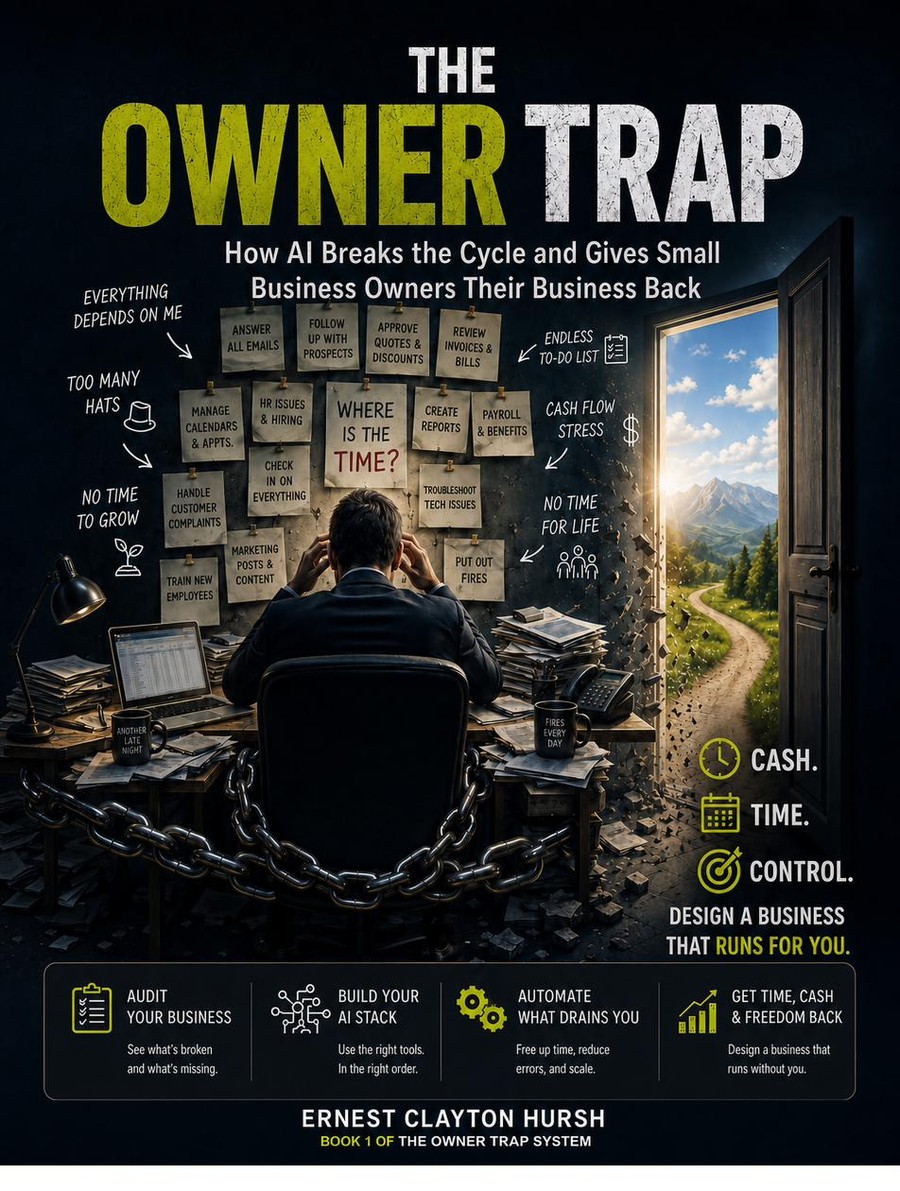
It's Monday morning. You've been up since 5 a.m., and you're already behind.
You're the first one in and the last one out. You close the sale, then you do the work, then you send the invoice, then you chase the payment. You're the marketing department, the operations manager, the head of customer service — and the person who takes out the trash.
The trap isn't a lack of effort. The trap is that the business runs on you.
Everything in it comes back to three things you can feel: your Cash, your Time, and your Control. If a change doesn't improve at least one of those, it doesn't belong in your business.
— Ernest Clayton Hursh, PrefaceRunning the business vs. leading it
Running the business means answering questions, following up, scheduling, invoicing, managing tasks, putting out fires. Leading it means setting direction, building key relationships, allocating capital, and making the judgment calls that require your specific experience and vision.
The average small business owner spends 23 hours a week on tasks that could be fully or partially automated — roughly $90,000 a year spent on operations instead of growth. Recovering 8 of those hours changes your business. Recovering 15 changes your life.
The Hair-On-Fire Problem
The transformation that would free you requires time you don't have — because you're spending all your time on the things the transformation would eliminate. Every chapter in the book ends with a Quick Win, everything is sequenced, and every chapter shows all three paths for getting it done.
Every task in your business sorts into one of three piles
This filter runs through every chapter — the tool that turns "AI could help here" into an actual decision.
High volume, low judgment
Repetitive, rule-based work that's already costing you hours a week. First in line for the machines.
Worth it, once the groundwork's in
Real savings are there, but they depend on cleaner data, a defined process, or a tool decision you haven't made yet.
The Never Automate Test
If a customer would feel undervalued, misled, or disrespected finding out a machine handled it — keep a human in the loop.
The Three Paths — who actually does the work
Sorting a task is only half the decision. The book walks through who executes it, at what cost, and how fast.
| Path | Who It's For | Cost Level | Time Investment |
|---|---|---|---|
| DIY | Owner with time, patience, and basic tech comfort | Lowest | Highest — 2–4 hrs/week over 90 days |
| Staff | Business with a capable ops or admin person | Mid | Moderate — your oversight, their execution |
| Firm | Owner whose time is scarce and speed of ROI matters | Highest | Lowest — 1–2 hrs/week for direction and review |
A note on the hybrid approach. Many owners land on a blend of Staff and Firm: bring in a firm to design and install the system quickly and correctly, then hand the day-to-day running to your own team. You get the speed and expertise of a firm without paying firm rates forever, and your people stay in control once the system is built. It costs more than going it alone but far less than keeping a firm on retainer — for most owners with a capable team, it's the best balance of speed, cost, and control.
Don't look like lunch.
Operational friction is what makes a small business look like lunch. Replace manual owner drag with reliable systems and you stop looking like lunch.
There ain't no rules.
Assume everything that can go wrong will. This is operational skepticism, not paranoia.
Cannibalize your business before someone else does.
Outdated practices and manual habits atrophy by the minute. Rethinking every step of your workflow is not optional.
Scale speed, not headcount.
AI closes the resource gap between small and large companies — permanently.
Seven rules in all, straight from the book's front matter — read the full set.
Inside the book
Each part builds on the last — from auditing what your business runs on today, to a scaling plan for what comes after the system is live.
Foundation
Audit what the business runs on, learn the AI basics, choose your path, build your stack.
Marketing & Lead Generation
Leads, content, and email — running without a marketing department.
Sales & Revenue
Fill the pipeline, win the deal, build playbooks, grow what you already have.
Operations, Finance & People
Cash flow visibility, scheduling and SOPs, hiring, and customer support.
Leadership & Scaling
What only the owner can do, diagnosing what won't fix itself, risk, and what's next.
Three tools to start with
Every worksheet, scorecard, and appendix from the book and workbook lives in the full library.
The Tool Evaluation Scorecard
Score any AI tool out of 18 before it earns a place in your Core Stack.
ExhibitThe ROI Calculator
Put a real number on what automation is worth to you this year.
Appendix GThe Leak Audit
Where AI finds the money quietly leaving your business — you stay the judge.
Two ways to put the book to work
And more books on the way — see the series roadmap ↓.
The Owner Trap App
Walks the book's method one module at a time, with worksheets, an ROI calculator, and a progress tracker across all 10 modules. Available as a one-time purchase: Essentials ($79) or Complete ($99), with no subscription.
Open aiownertrap.online →The Companion Workbook
All 10 modules, every worksheet, room to actually work — plus the full AI Tools Reference Guide and 90-Day Implementation Roadmap in the Premium edition.
See the workbook →The industry editions are next
The Owner Trap method, applied industry by industry, in order of urgency: Real Estate, then HVAC & Trades, then Medical/Dental, Insurance, Retail, Restaurants, and Professional Services.
Stop answering texts before 7 am.
Get the book that turns AI from one more thing to figure out into a system that runs without you.